B2C e-commerce templates are seductive. They are quick to launch, relatively inexpensive and polished straight out of the box. For B2B businesses under pressure to modernise quickly, they can feel like a sensible shortcut. In practice, they are one of the most common reasons B2B platforms underperform commercially.
The issue isn’t quality. It’s fit.
B2B buying behaviour is fundamentally different from consumer purchasing, which is why a well-designed B2C journey rarely transfers cleanly. Consumer sites are built around impulse, emotion and simplicity, while B2B buying is deliberate, repeat-driven and shaped by commercial relationships that extend beyond the website.
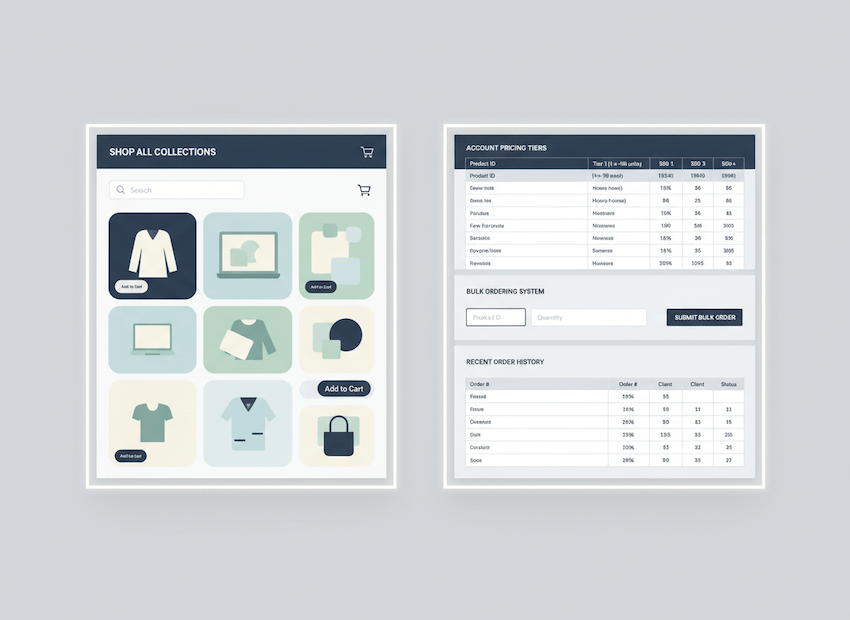
B2B buyers expect to log in and see their pricing, their products and their terms. They need to reorder quickly, manage multiple users, download documentation and, in some cases, route purchases through approvals. These are not edge cases. They are core requirements, and most B2C templates do not support them natively.
Templates can be customised, but those customisations accumulate over time and eventually begin working against the framework itself.
Templates push cost into the future
One of the biggest misconceptions about templates is that they save money. They often do at the start, but over time the cost shifts from build to maintenance.
As business requirements grow, teams add plugins, workarounds and patches to compensate for missing functionality. Each addition increases complexity and technical debt, so changes take longer, updates become riskier and performance starts to degrade.
From a leadership perspective, this is where frustration sets in. Investment continues, but the platform feels increasingly fragile and resistant to change.
Marketing and sales pay the price
Templates also constrain how effectively marketing and sales teams can operate. When content structures are rigid and product data models are shallow, campaigns struggle to land cleanly. Landing pages are harder to tailor, account-based experiences are limited and personalisation remains superficial.
Sales teams feel the same problem from another angle. If the platform cannot reflect negotiated pricing or customer-specific catalogues, they stay heavily involved in transactions that should be self-service. Instead of reducing workload, the site adds another layer of operational effort.
That weakens one of the main reasons businesses invest in e-commerce in the first place.
Custom doesn’t mean over-engineered
Rejecting templates does not mean building everything from scratch. It means designing around real buying processes rather than forcing the business to adapt to a predefined structure.
Well-designed B2B platforms balance flexibility with control. They support complex pricing and catalogue rules while remaining manageable and scalable, and they are built to evolve as the business grows rather than only to satisfy current requirements.
That also makes ongoing optimisation more straightforward because changes align with how the platform was intended to function, rather than working against it.
Shortcuts rarely survive growth
Templates can work for simple, early-stage use cases. The problems usually emerge once volume, complexity or ambition increases, at which point the quick win becomes a structural constraint that is expensive and difficult to escape.
For businesses serious about using digital channels to drive revenue, the question is not how quickly a site can be launched. It is whether the platform can support how customers actually buy, now and in the future.
Choosing the right foundation early avoids painful compromises later and allows e-commerce to operate as a commercial asset rather than a limitation.