

Map the Process
Understand the people, systems, data and exceptions involved in the real workflow.
ERP, CRM & API integrations
When ERP, CRM, ecommerce and operational systems do not exchange information properly, people end up filling the gaps with spreadsheets, rekeying and manual checks.
Structurell designs, improves and troubleshoots integrations so the right information moves between systems reliably, with clear ownership when something goes wrong.
Common integration problems
An integration is not successful simply because data moves from A to B. It needs to be reliable enough that people can stop working around it.
Teams are copying customer, order, product or pricing information between systems because no single flow can be trusted end to end.
Something stops syncing, but nobody can quickly tell where the failure happened, what was affected or who owns the fix.
Pricing, stock, account rules or business logic has been duplicated across systems and now behaves differently depending on where it runs.
The integration has grown without clear boundaries, making routine upgrades or platform changes much riskier than they should be.
Connected business systems
We look at what the data means to the business, which system should own it and what needs to happen when the normal flow fails.
Clear ownership and dependable movement between systems.
Catalogue, customer accounts, pricing, orders and self-service workflows.
Internal applications, portals and operational systems with their own data and processes.
Data movement that supports reporting, workflow automation and better operational visibility.
Products, stock, pricing, customers, orders, fulfilment and financial data.
Customer records, opportunities, account information and sales activity.
Payments, logistics, suppliers, marketplaces, identity services and specialist APIs.
A lot of integration problems are really ownership problems.
If several systems can all update the same customer, product or pricing information, the technology quickly becomes harder to reason about and failures become harder to recover from.
Structurell helps define where important data should live, which direction it should move and what each system is responsible for before adding more technical complexity.
How the systems actually meet
Most integration problems are not transport problems. They are ownership problems: two systems both believe they hold the true price, or an order is accepted in one place and lost in another.
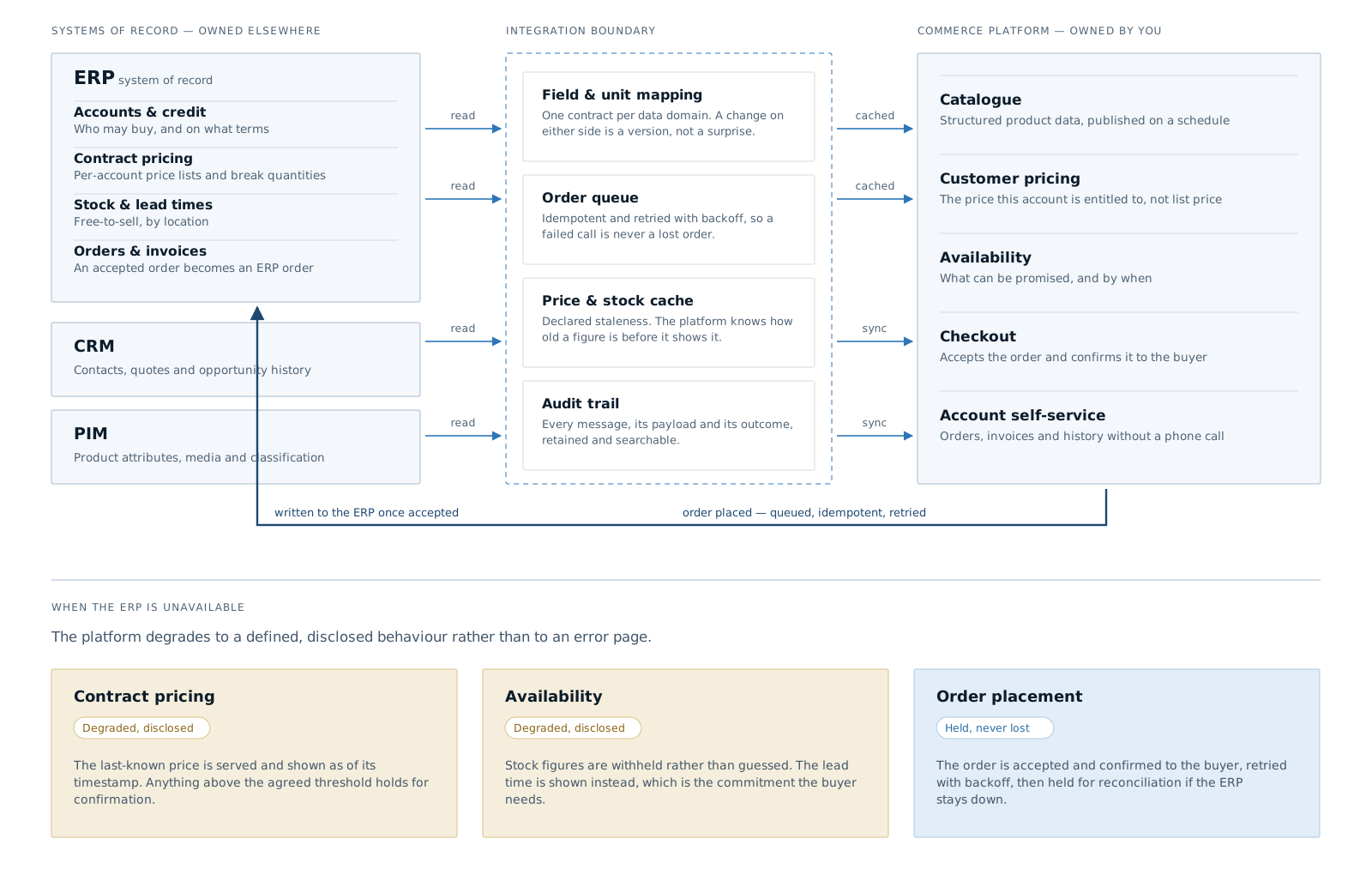
How we approach integration work
The API is only one part of the problem. The useful design starts with what the business expects to happen from beginning to end.
Understand the people, systems, data and exceptions involved in the real workflow.
Decide which system owns each important piece of information and where business rules should live.
Implement the APIs, events, queues or scheduled processes needed to move data reliably.
Logging, retry behaviour and monitoring make it clear when something has failed and what needs attention.
What good integration looks like
The goal is not simply to move data. It is to make the process dependable enough that the business can operate around it with confidence.
Everyone knows which system is responsible for each important piece of data.
Retries, exceptions and manual intervention are designed rather than improvised after something breaks.
Failures and unusual behaviour are visible before users have to discover them.
Retries and duplicate events do not quietly create duplicate orders, records or other unintended effects.
A future upgrade to one system should not require understanding an undocumented chain of side effects elsewhere.
Pricing, stock and customer logic are not duplicated unnecessarily across every connected system.
Existing integrations
Sometimes the sensible answer is to stabilise what exists, improve visibility around it and remove the highest-risk parts gradually.
If the current integration genuinely needs replacing, we can establish that from the evidence rather than starting with a rebuild assumption.
After delivery
Integrations continue changing as APIs, platforms and business processes evolve. Ongoing technical assurance can help catch problems before another workaround becomes permanent.
Track failures, queues, slow processes and relevant production behaviour.
Review changes to integrations, APIs and surrounding systems where technical risk is higher.
Use evidence from real operation to decide where further engineering is actually worthwhile.
Relevant experience
Integration work sits behind much of Structurell's commerce and business software experience rather than existing as an isolated technical exercise.

Vohkus
Engineering around Adobe Commerce, large catalogues, pricing and surrounding systems in an environment where reliable data movement is operationally important.

Total Computers
B2B commerce architecture shaped around account logic, system responsibilities and future integrations.
Systems not talking properly?
You do not need to arrive with an API specification. Explain what information is moving today, where the manual work or failures sit and what the process should look like instead. We can work backwards from there.
Stay in the loop.
Useful ideas on software, AI and technical decisions.
Contact
© 2026 Developed with Style Limited (trading as Structurell)
Company No. 10176636 · VAT No. GB 296 474 257